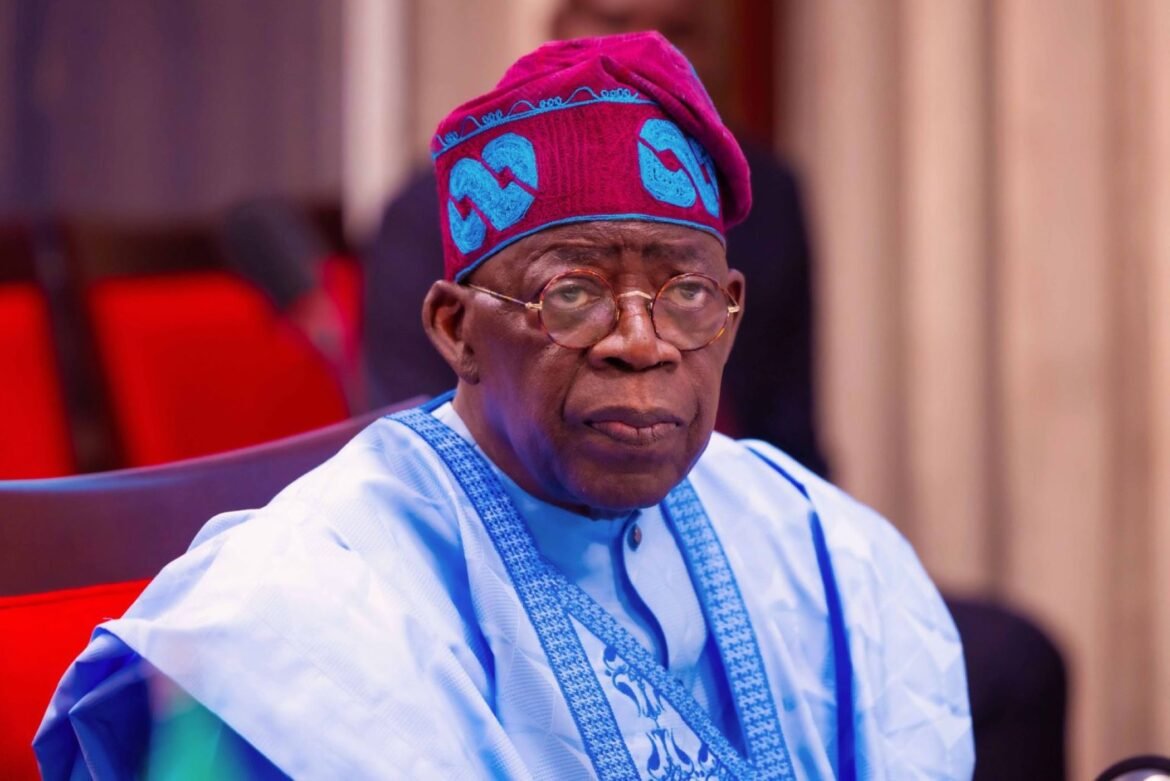
Every now and then, former president and one-time military ruler, Olusegun Obasanjo offers insights and snippets of information on what is happening within successive Nigerian governments that have been elected to office since he served out his owned two terms.
And sometimes, he links his assessment to the past, to emerging events in the West African region and global geopolitics.
What he never does, is delve into these policy and political decisions made by the Nigerian presidents, and whether they are entirely shaped by domestic considerations or influenced by Western powers, particularly the United States of America, France and Great Britain.
One such occasion came in a television interview he just gave.
Obviously referring to President Bola Ahmed Tinubu, Obasanjo accused him of destroying the Economic Community of West African States (ECOWAS).
The former president said that, overnight, Tinubu destroyed an institution which took regional governments 50 years to build.


It can be said that Obasanjo and other past leaders have not been wholly transparent about how they conducted foreign diplomacy
He zeroed in on how Tinubu responded to the July 2023 coup d’état in Niger Republic threatening and mobilising to use force to restore the ousted elected president, Mohamed Bazoum.
Obasanjo then elaborated on Nigeria’s past relationship with Niger and the familial relationships between the peoples of the two countries.
There are two parts and several audiences to this assertion made by Obasanjo.
Both aspects, one domestic and the other international cannot be separated from the upcoming 2027 presidential election.
The audience and impact of the first, which is on the social and cultural relationship between Northern Nigeria and Niger Republic, could drive a political wedge between Tinubu, his re-election bid and political leaders in the north.
It is pertinent to note that the resistance to using military force in Niger came mostly from outside political and diplomatic circles.
In what seemed like an unprecedented intervention in Nigeria’s foreign policy, a delegation led by Sheikh Bala Lau, the national chairman of JIBWIS flew to Niger Republic and met with the coup plotters led by Abdourahamane Tchiani to try and douse tensions and ward off the impending military action.
The second audience is the international community, western powers that have seen their influence wane in West Africa and have even been kicked out military bases across the region and replaced with Russian influence, military forces and with them taking over mining rights and other business opportunities.
It can be said that Obasanjo and other past leaders have not been wholly transparent about how they conducted foreign diplomacy.
He needs to do a better than this.
He owes Nigeria and maybe all of Africa a better explanation on the role western powers have played and continue to play in regional politics, in the formation of governments and even in the founding of ECOWAS back in 1975.
It is no secret that in Francophone West Africa, most governments, until recently could not lift a finger on the international stage without the consent of France, much less join a regional body to coordinate trade and security.
Nigeria too has had to put the interest of the United States and other world powers into consideration in decision made within ECOWAS, whether it was military intervention in Liberia, Sierra Leone, Ivory Coast or The Gambia.
Even the more recent establishment of the Multinational Joint Task Force that was formed during the Sani Abacha regime, to manage the insecurity around the Lake Chad region, it had to be coordinated with both France and the United State.
The task force included Nigeria, Benin, Chad, Cameroon and until it pulled out in 2025, Niger.
In that sense, what Obasanjo needs to shed light on is why Nigerians should not see ECOWAS as a tool for western imperialism and modern day colonialism.
Partly because the military have dominated governance all over West Africa over the last 60 years, leaders like Obasanjo are better informed about geopolitics, foreign policy and the influence world powers exert on African governments.
In spite of Obasanjo’s posturing, he has always been at the beck and call of US presidents and British prime ministers.
The same can be said about other military leaders in Nigeria.
They knew their limits and were well informed about the extent western powers were willing to go to protect their security and business interests.
As a military head of state, Ibrahim Babangida, charmed his way into the hearts of world leaders.
He also brought out the best from Nigeria’s career diplomats.
Understandably, many military and intelligence officers in Nigeria have just as much exposure on a diplomatic level as do career diplomats. Diplomacy, after all is the first line of defense.
They have also had the interest.
Based on conversations within the diplomatic community in Nigeria, one major reason the United States and Europe withdrew support from the Goodluck Jonathan government was because they were finding it difficult to coordinate security responses across West Africa.
Nigeria was supposed to be a central coordinating hub but the Jonathan government frustrated their efforts.
The trust deficit between the Jonathan government and the outside world extended to Nigeria’s neighbors.
So, the US and its partners turned to Muhammadu Buhari, a former military head of state.
Now the same thing that played out under Jonathan appears to be happening under Tinubu, and at a time the US is trying to counter the growing influence of China and Russia.
While Jonathan wanted to hide Nigeria’s insecurity from outside scrutiny, it is the flow of money and the politics Tinubu seeks to keep from prying eyes.
Nigeria’s defence and security establishment has always taken diplomacy seriously.
It was not only the fate of the country that depended on it.
Their own lives were also at stake.
Joe Garba, a military officer, is today still regarded as one of the most dynamic foreign affairs minister that Nigeria has ever had.
He served in a period when the country’s foreign policy was seen as relatively independent and supportive of other African countries against western influence.
Yet, there have always been conspiracy theories about America’s Central Intelligence Agency, French and Belgian intelligence been behind some coups, including those against Murtala Mohammed in Nigeria in 1976, Thomas Sankara in Burkina Faso in 1987 and the most famous one, which a 93-year-old Belgian intelligence officer was last month put on trial for; the killing and dismembering of Patrice Lamumba of the Democratic Republic of Congo in 1961.
In the 60s and 70s, that relative independence would serve as a hindrance to the establishment of ECOWAS.
There is no denying it, ECOWAS has helped keep the peace in the sub-region.
It has helped foster trade and economic ties.
And yes, the willingness of President Tinubu to intervene militarily in the Niger coup was supported by President Emmanuel Macron of France and President Joe Biden of the United States.
It was also the catalyst that led to the withdrawal of Niger Republic along with Burkina Faso and Mali, two other countries where military officers had overthrown elected presidents, from ECOWAS to eventually form the Alliance of Sahel States.
The threat of force eventually led to the expulsion of French and US military forces from these and other West African States.
But even before the coups, the influence of French in a number of ECOWAS states had become politically toxic and a source instability in the region.
In that sense, the regional institution was already in trouble.
Tinubu just hastened the decline.
Obasanjo can still be right that it was inexperience in geopolitics that led Tinubu to make fatal decisions in the management of the regional body.
But the argument can still be made that moves by Tinubu to first diminish the political and economic standing of the body and then reduce Nigeria’s role in it was deliberate.
This would help Tinubu consolidate power locally by removing foreign influence from Nigeria’s politics.
But it isn’t just ECOWAS that Tinubu has reduced engagement with, it is with all of Africa and all of the world
We have seen this happen elsewhere in the world.
In furtherance of his America first agenda, President Donald Trump, has for 10 years railed against the North Atlantic Treaty Organisation (NATO), a defence body built to counter Russia in Europe.
But nothing he has said or done has really shaken the alliance, except when he threatened to invade Greenland, a semi-autonomous region of Denmark.
Stepping back from the alliance and other international institutions is supposed to strengthen Trump locally.
Now the Europeans are planning for the own defence, for a NATO without America and are rebuilding their arms industry.
But it isn’t just ECOWAS that Tinubu has reduced engagement with, it is with all of Africa and all of the world.
For three whole years, the president refused to nominate ambassadors to represent the country across the globe.
This is no accident.
When he finally did, it was in response to a crisis with the US government that threatened Nigeria’s stability.
The ambassadorial nominees were also filled with individuals without foreign policy or intelligence experience.
It is simply not enough to suggest the president cut off funding for ECOWAS and delayed appointing ambassadors to preserve money like has done in every sector from health to education and defence not withstanding budgetary allocations.
Again, the purpose of the lack of engagement, dumbing down the diplomatic engagement and personalising it, is to consolidate power locally.
Career diplomats go out to represent a country’s interest.
Political appointees have a different set of agendas.
And in the long run, this could be hugely consequential for Africa, ECOWAS and Nigeria’s place in the world.
But both Obasanjo and Tinubu might just be playing a similar kind of game.
Obasanjo is drawing in the international community to pay more attention to the upcoming election by highlighting a weak foreign policy and regional security failures.
Tinubu wants to keep the international community at bay by domesticating and detaching Nigeria from West Africa both economically and on the security front.
Obasanjo may also want the Niger Republic debacle to become a political issue and put a cultural and aspirational gap between the president and the north in view ahead of 2027.
But the Tinubu presidency has also not been sleeping.
They just opened up two separate trials for alleged coup plotters.
One in a Federal High Court in Abuja and the other a military court-martial.
Virtually all of the defendants are from the north.
The influence of western powers over Africa has waned or evolved to offer a semblance of independence
There are still political grievances in parts of the country over the sense of entitlement and how the north has dominated governance since independence.
Just nine months to the next presidential election, the presidency’s timing couldn’t be better.
There couldn’t be a better spectacle to distract attention from other realities, and to deepen those grievances for political ends.
Maybe Nigeria no longer needs diplomats in the likes of Joe Garba and others that operated in the shadows.
The influence of western powers over Africa has waned or evolved to offer a semblance of independence.
Cross border insecurity can be contained and restricted to a handful of northern states.
And in the end, for a country like Nigeria with 220 million people, all politics, as a saying goes, is local.
So, weakening ECOWAS is not necessarily a failing.
It could be strategy.
What happens in Niger, Mali, Chad and ECOWAS doesn’t really matter.
Not to the Tinubu government.