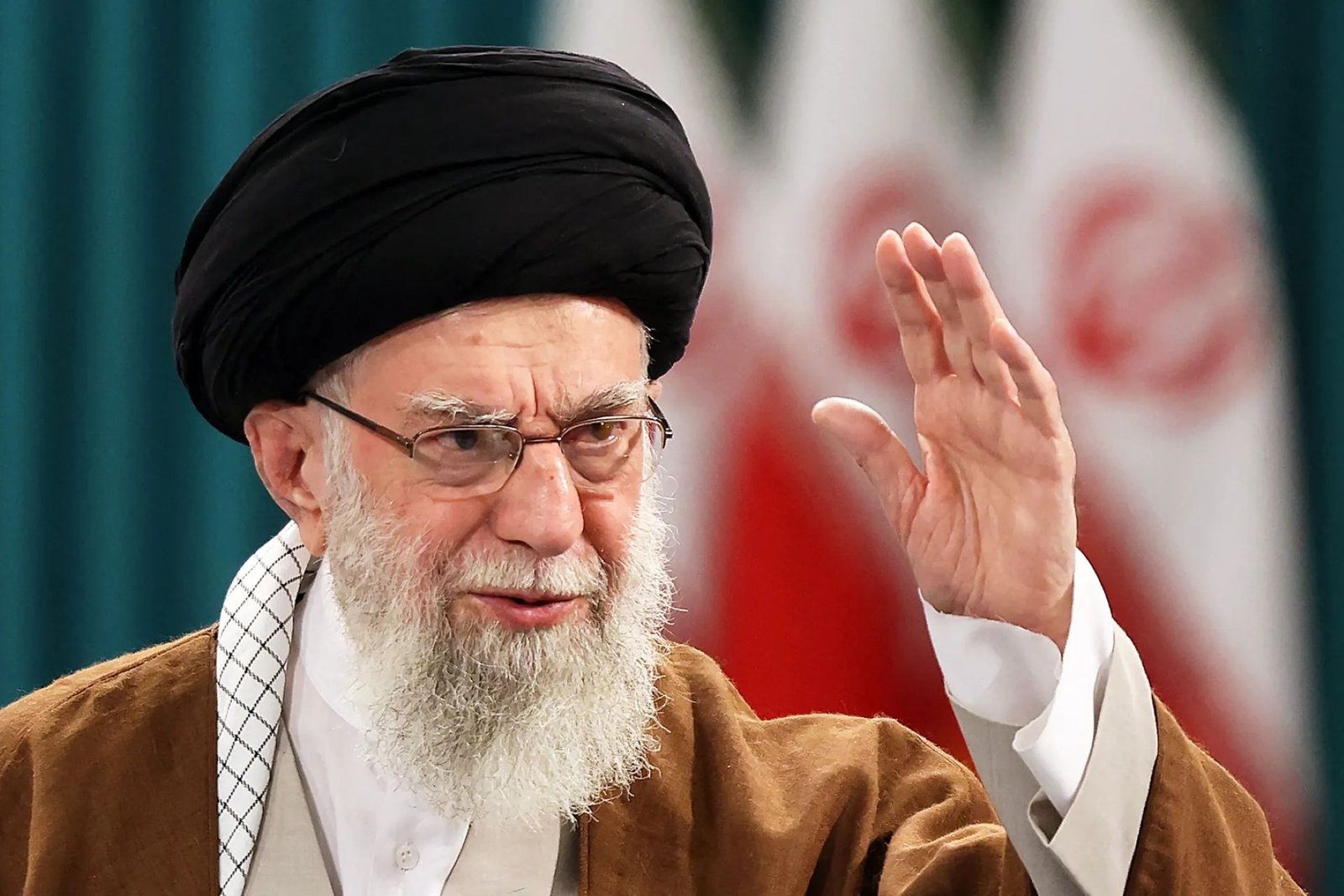
As soon as news spread about airstrikes in Iran, some Nigerians took to the streets in protest.
In Kano, Sokoto, Niger, Yobe, Bauchi, Gombe, and Kaduna, protesters carried portraits, flags, and placards of Iranian Supreme Leader Ayatollah Khamenei, forcing the US Embassy to suspend operations in response to the demonstrations.
For an event with no direct bearing on Nigeria, police felt compelled to direct commissioners across all 36 states and the Federal Capital Territory to heighten surveillance and prevent escalation.
It is deeply concerning to witness a growing segment of Nigerians abandon rational thinking and respond to international crises through a purely religious lens, regardless of the conflict’s actual nature.
Yet the facts are damning.
Just a month earlier, Iran’s rulers had massacred thousands of their own citizens for daring to protest economic hardship—a crackdown widely regarded as the worst in Iran’s modern history.



Food inflation exceeded 70 percent, wage stagnation was rampant, and strikes in Tehran’s influential bazaar markets had ignited nationwide protests.
The economic desperation was worse than what Nigerians themselves have endured recently.
But Iranians refused to suffer in silence. Protesters escalated from complaints to demands for the end of the Islamic Republic and the 36-year rule of Ayatollah Khamenei.
They fought for democracy and an end to dictatorship.
Will Nigerians tolerate a ruler for 36 years?
We will not.
Gowon, Babangida, and Abacha were removed once they showed signs of staying beyond their time.
The death toll was staggering.
By late January, reports indicated that approximately 6,400 protesters, including over 100 minors, and more than 200 security personnel had been killed, with over 11,000 additional deaths still under investigation.
News outlets estimated that at least 12,000 civilians were killed in just two days in January, while some estimates suggest the toll may reach 30,000.
Yet when these killings were reported, Nigerian protesters voiced no concern.
They showed no outrage over the massacre of ordinary Iranians – students, workers, families, children.
They expressed no alarm about internet blackouts, mass shootings, or mass arrests.
They were indifferent to the brutality of a regime crushing its own people.
Everything changed when the United States and Israel responded militarily – not because the protesters suddenly cared about Iranian civilians, but because they opposed any attack on their tribe.
Iran has since responded with barrages of drones and missiles against Israel and US bases across the region, disrupting air traffic through the world and striking countries uninvolved in the conflict.
Mobs in Nigeria chanted religious slogans as they flooded the streets. Banners proclaimed solidarity with Iran.
They aligned themselves with a government that murders its own people.
The spectacle was both revealing and troubling.
These protests reflect a growing religious fanaticism in Nigeria that must be named and challenged.
The protesters may dislike Israel and the United States – a legitimate political position – but they chose the wrong cause at the wrong moment.
Their message was unmistakable: the enemy of America is our friend; this is a religious war.
It is such bigotry that has enabled the rise of movements like Maitatsine and Boko Haram – extremists who demand a Nigeria defined solely by their religious worldview. It is a root cause of instability and insecurity.
But let us examine what these protesters were actually celebrating – and what we conveniently ignore.
The thousands of Iranians killed were ordinary people who dared to protest bad governance.
That is citizenship.
It was met with bullets, beatings, and imprisonment.
The Islamic Revolutionary Guard Corps -whose commander America eliminated – led this crackdown. Supreme Leader Khamenei, whose photograph adorned the protest banners, ordered the massacres.
He showed no remorse, no accountability, no concern for the blood he shed.
Would these Nigerian protesters accept the same from their own government?
If Nigerian security forces shot thousands of demonstrators in Abuja, Lagos, or Kano, what would they demand?
They would cry foul, invoke human rights and demand justice.
We would rightfully condemn such actions as barbaric and authoritarian.
How do we reconcile these positions?
How do we protest in solidarity with a regime that murders its own people while simultaneously claiming to stand for justice and human values?
The answer lies in what can only be described as Nigeria’s religiosity problem: the persistent habit of evaluating events not on their merits or principles, but through the narrow lens of religious identity.
Let me be clear: this is not a problem unique to Islam.
Many Nigerian Christians exhibit the same weakness.
Some feed on Christian nationalism from the United States, consuming conspiracy theories and spreading misinformation with fervent abandon. Among them are pastors and educated professionals.
When conflicts involve majority Muslim, Christian, Arab, or Western nations, many such people abandon critical thinking and moral clarity.
They drop their principles to become partisans – not of justice, but of religious tribe.
This is intellectual laziness at best, moral bankruptcy at worst.
The consequences are profound.
This mindset blinds us to atrocities committed by those we consider “our people.”
It makes us apologists for dictators simply because they share our faith.
It creates a double standard where moral scrutiny applies only to adversaries, never to allies.
It fundamentally undermines our credibility as a nation that claims to value justice, human rights, and the rule of law.
What should guide our response to international events?
The answer is straightforward but demanding: principles – consistent, non-negotiable principles applied equally to all parties, regardless of religious identity or geopolitical alignment.
We must use human rights and the rule of law as our measuring stick. When any government – whether in Washington, Tehran, or Abuja – violates international law, we must condemn it.
The American strikes on Iran raise legitimate questions about proportionality, due process, sovereignty and international law.
These concerns deserve serious debate.
But we cannot voice them while simultaneously celebrating Iranian aggression against its own people and through its proxies.
We must hold human rights as non-negotiable: the right to life, peaceful assembly, and freedom of expression.
These are not Western impositions but universal rights grounded in our common humanity.
Any government that murders citizens for protesting forfeits automatic sympathy, regardless of its religious credentials.
And we must demand decency from all parties.
Decency means opposing civilian casualties in Iranian cities, its neighbouring countries and the Strait of Hormuz.
It means supporting peace over war, dialogue over confrontation, justice over revenge.
The great danger facing Nigeria is that we are becoming a nation of tribal moralists – people who apply one standard to religious allies and another to perceived enemies.
This is not religion; it is tribalism masquerading as faith.
Criticising Iran’s human rights abuses does not mean endorsing American militarism.
Both can be wrong simultaneously.
Both must be held accountable.
Our moral framework must be expansive enough to hold both truths at once.
This is not confusion; it is clarity – the clarity that comes from anchoring ourselves in principle rather than identity.
We can do better. We must do better.