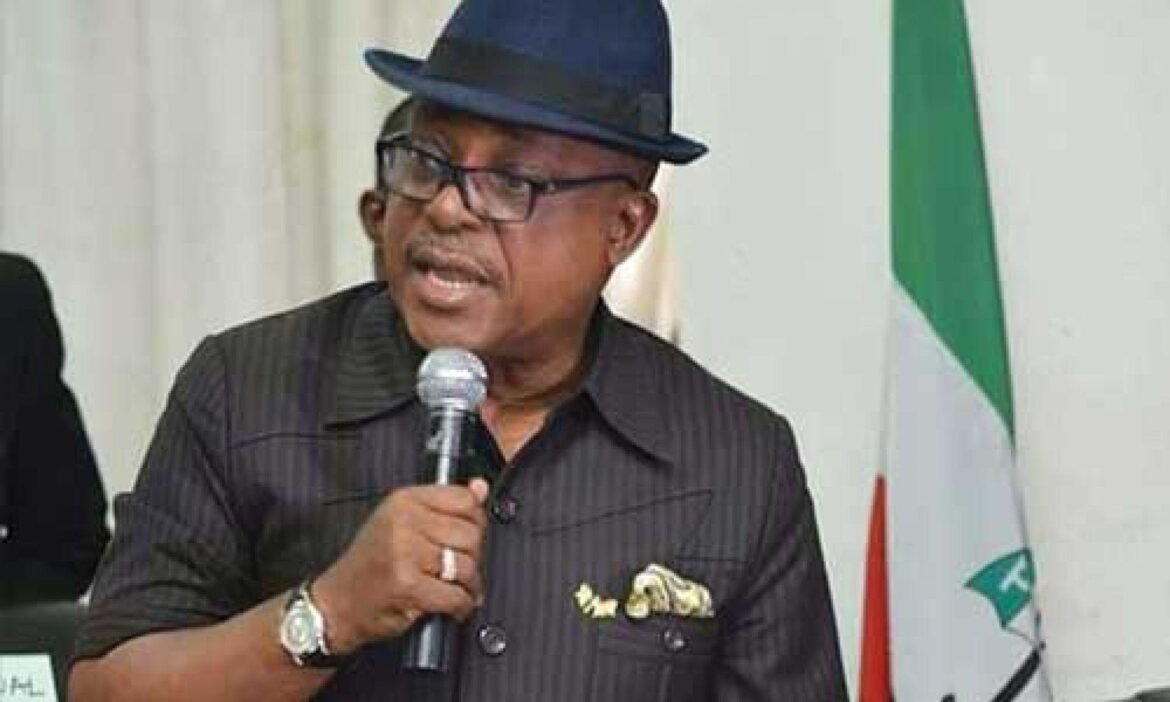
There’s a photograph making rounds on Nigerian social media that perfectly captures everything wrong with how wealth works in this country.
It shows Pastor Enoch Adeboye, General Overseer of the Redeemed Christian Church of God, hands raised in prayer, blessing a sprawling mansion in Port Harcourt that could house a small village.
The house belongs to Mr. Uche Secondus, former National Chairman of the People’s Democratic Party.
The price tag is five whopping billion naira.
Let that number sit with you for a moment.
In a country where the minimum wage is 70,000 naira per month—about $44 at current exchange rates—and most workers don’t even get that.






In a country where millions of children are out of school because their parents can’t afford the fees.
In a country where public hospitals lack basic equipment and pregnant women die from preventable complications.
Five billion naira for one man’s house is an audacity that is breath-taking.
Where Did the Money Come From?
This is the question that burns at the centre of every display of wealth by Nigerian politicians.
Secondus wasn’t born with a silver spoon.
He worked his way up through the ranks of Nigerian politics, right from his youth, serving in various capacities before becoming the PDP’s national chairman when the party controlled the levers of federal power.
Politics in Nigeria doesn’t pay salaries that create billionaires through honest means.
It rewards corrupt people.
The usual route to amass that kind of wealth in Nigerian politics is through the systematic looting of public funds, inflated contracts, kickbacks, and the complex web of corruption that has become our country’s operating system.
Apart from being a political leader, Secondus has had the usual opportunity to amass wealth as the first Chairman of the Governing Board of the National Identity Management Commission (NIMC).
He was a guest of the Economic and Financial Crimes Commission (EFCC) in 2016, but the case landed in the desert, like most other corruption cases in Nigeria.
Secondus’ appeared in the ‘looters list’ released by Lai Mohammed, Minister of Information and Culture during the Buhari administration, for allegedly taking cash from the Office of the former National Security Adviser, Sambo Dasuki, for unknown work.
But this story isn’t about Secondus alone.
It is about the priority of Nigeria’s political class, which takes with both hands, build monuments to its own glory, and then invite religious leaders to sanctify theft with prayers.
The Real Value of Five Billion Naira
What does five billion naira actually mean in a country where the majority live on less than 3,000 naira a day?
It means 71,428 students could receive full university scholarships for four years.
It means 50 rural health clinics could be built and equipped to global standards.
It means 1,000 classrooms could be constructed in underserved communities.
It means 5,000 small businesses could receive seed funding to employ tens of thousands of Nigerians.
Instead, it bought one man a house.
Not a house that will provide shelter for the homeless.
Not a facility that will heal the sick or educate the ignorant.
Just a house to sleep in and brag about.
A monument to ego wrapped in marble and gold.
The opportunity cost of this single building is staggering.
Every naira spent on imported Italian tiles and crystal chandeliers is a naira not spent on Nigerian children.
Every fixture shipped from Europe represents hope stolen from communities without clean water.
Every room that will sit empty most of the year represents a classroom that will never be built.
Secondus’ house is a close-up view of inequality.
If Not the House, What?
Secondus is 70 years old.
He has already lived more than the average Nigerian will ever see – life expectancy hovers around 55 years.
At 70, what does a man need with a five-billion-naira palace?
This is the age when wise men think about legacy, about what they’ll leave behind when they’re gone.
But many in the Nigeria’s political elite don’t think in terms of legacy for the nation – they think only of personal monuments.
Secondus could have built a hospital system that would serve Rivers State for generations.
Instead, at 70, he chose a house.
His house that will stand as a permanent reminder of selfishness, greed and his fundamental disconnection from the suffering of his own people.
When historians write about this era of Nigerian politics, buildings like this will be Exhibit A in the case against our political class.
The Pastor’s Blessing
And then there’s Pastor Adeboye, standing in that mansion, blessing what should never have been built.
This moment deserves its own examination.
Watching a man of God bless the fruits of unverified wealth itself is an insult – a public declaration that God approves of this obscene accumulation while His children starve in the streets below.
Pastor Adeboye leads one of Africa’s largest churches, preaching a prosperity gospel that tells people God wants them to be wealthy.
Fair enough—poverty is not a virtue, and there’s nothing wrong with aspiring to financial security.
But the man of God could have found a better place to be associated.
Jesus Christ had some very specific things to say about rich men and the kingdom of heaven.
He overturned the tables of money changers in the temple.
He told a wealthy young man to sell everything and give to the poor.
He said it’s easier for a camel to pass through the eye of a needle than for a rich man to enter heaven.
The Stinginess of Nigeria’s Rich
Here’s what makes this all the more galling: Nigeria’s wealthy aren’t just corrupt—they’re also extraordinarily stingy.
Unlike their counterparts in the United States and Europe, they give almost nothing back to society.
Bill Gates has donated over $36 billion to his foundation, funding global health initiatives, education programs, and agricultural development, with Nigeria as a beneficiary.
Warren Buffett has pledged 99% of his wealth to philanthropy—over $60 billion and counting.
These men built libraries, fund scholarships, support medical research, and invest in public goods that benefit millions.
In Nigeria, our billionaires build personal palaces and call it success.
There are exceptions, and they deserve recognition.
Mobolaji Bank Anthony gave so much for common good in his lifetime, including a section called Ayinke House at today’s Lagos State University Teaching Hospital.
Folorunsho Alakija recently donated a 250-bed medical research and training hospital to Osun State University – a facility valued at 35 billion naira, equipped with cutting-edge technology including MRI scanners, CT machines, modern operating theaters, and research laboratories.
The Modupe and Folorunso Alakija Medical Research and Training Hospital will train the next generation of Nigerian doctors and serve communities that have never had access to such advanced care.
This is what transformative philanthropy looks like.
This is how you build legacy.
Most of Nigeria’s wealthy do nothing remotely comparable.
They don’t build schools.
They don’t endow hospitals.
They don’t create foundations that address systemic problems.
They attend lavish parties where they spray cash on each other, they build houses that could shelter hundreds, they host birthday parties on foreign yachts, and they buy private jets.
A Challenge to Nigeria’s Rich
So, here’s my message to Uche Secondus and everyone like him: You’re doing it wrong.
Your five-billion-naira house is not a testament to your success – it’s evidence of your failure as a human being.
It’s proof that you took from a starving nation and gave nothing back.
It’s a monument not to achievement but to greed, not to vision but to myopia, not to greatness but to the smallness of your mind.
The rich, especially in old age, should stop building palaces and start building the Nigeria that could have been.
Build hospitals.
Build schools with libraries and science labs.
Build roads.
Build water systems that bring clean drinking water to.
Build power infrastructure.
When you build for the community, you build life and hope.
Build something that matters.
Build something that will outlive you.
Build something that will make the next generation say your name with gratitude instead of disgust.
The American robber barons of the Gilded Age – the Carnegies and Rockefellers who built their fortunes through exploitation and monopoly – eventually realised they needed to give back.
They built universities, libraries, hospitals, and research institutions that transformed American society.
They understood that there’s no honour in dying the richest man in the cemetery.
Nigeria’s wealthy need to learn this lesson before it’s too late.
Because right now, all they are building is resentment and public anger.
The house that Secondus built will stand for a while.
It will house his family in comfort while millions suffer outside its gates.
It will be photographed and shared online as evidence of how far we’ve fallen as a nation.
And one day, when Nigeria finally decides to reckon with this era of brazen theft and conspicuous consumption, it will stand as evidence in the trial of a generation that had everything and gave back nothing.
Build something better.
While there’s still time.